

Nervous System
The Apology Reflex: Why You Say Sorry for Taking Up Space
If you say sorry before you ask a question, before you take a seat, or before you say something that was never an offence, you are not being polite. You are running a protective habit. The apology reflex is a nervous system strategy that once kept someone in your family safe, and it fires faster than thought because it was never stored as thought.
What is the apology reflex?
It is the automatic sorry. The one that arrives for taking up space, asking for a small thing, needing a moment, or simply existing in a room with other people.

Notice the timing. A chosen apology comes after you have weighed something and found you caused harm. The reflex comes first, before any weighing happens at all. That gap in timing is the tell. When a response outruns your judgment, it is not coming from your values. It is coming from your wiring.
It usually travels with company. The reflexive brace when someone raises their voice, even in a room where nobody is angry with you. The urge to make yourself smaller the moment you are invited to be fully seen. The quiet sense that you are responsible for everyone else's mood.
Why does your body do this before you can stop it?
Because your alarm system is faster than your reasoning, by design.

When your brain reads a situation as risky, it does not send the question upstairs for discussion. It acts. Harvard Health describes the body's stress response as a cascade that begins before conscious thought. That is what you want when a car swerves at you, and it feels baffling when the threat is a colleague asking who moved the meeting.
For a child in a tense home, shrinking worked. Getting there first with an apology could defuse a room. Taking up less space meant drawing less attention. That is not weakness, it is intelligent adaptation, and the nervous system files anything that works as a rule to keep.
The body remembers what the mind has forgotten. If you have noticed reactions that feel older than your current circumstances, that pattern is explored more fully in healing patterns you did not start.
Did I inherit this, or learn it?
Often both.

Children absorb the emotional weather of a home long before they have language for it. You watch how the adults around you handle conflict, and you copy the posture. If the people who raised you braced, hid, kept the peace, or stayed vigilant, your system calibrated to match.
There is a biological layer underneath the behavioural one. Research on epigenetics describes how environment can influence the way genes are expressed without altering the DNA itself. You did not inherit an apology. You may well have inherited a baseline that leans toward protection rather than rest, which is fertile ground for one.
Here is the part worth holding gently. The script was born in love. Someone stayed small to survive something real. Someone swallowed grief to keep working. Their strategy kept them alive, and because they survived, you are here. Healing it is not a betrayal of them. It is saying thank you, and I will take it from here.
How do you begin to unlearn it?
Slowly, and with curiosity rather than a crackdown. Trying to force the reflex to stop just adds a new thing to apologise for.

Notice without correcting. For one week, only count. Every time the reflex fires, note where you were and who was there. You are gathering evidence, not building a case against yourself.
Ask the three questions. Does this reaction feel older than my current circumstances? Does this fear match the reality of this moment? Does this belief sound like my own voice, or like someone else's? Naming a pattern puts space between you and it, and that space is where choice lives.
Swap the sentence. Sorry for the long message becomes thank you for reading all this. Sorry to bother you becomes do you have a minute. Same courtesy, no self erasure.
Work at the body level too. Insight alone rarely shifts a reflex, because the reflex does not live in the part of you that reads. Regulation practices retrain the underlying setting, and the mechanics are in vagal tone exercises for your hidden engine. If shrinking has left you carrying other people's feelings as your own, how to stop taking things personally covers that half of the load.
When should you talk to someone qualified?
If the urge to shrink is tied to memories that feel unsafe to approach alone, please do not do this work by yourself. A licensed trauma-informed therapist is the right companion for that terrain, and this article is no substitute for one. Persistent low mood, panic, or anything affecting your daily functioning deserves an honest conversation with your physician first, not instead.

Alongside that care, nervous system and emotional overwhelm support is the patient work of teaching a protective body that the danger has passed. If that is where you are, you can send me a note through my contact page, or start quietly with my free guide.
Pause for reflection
Rest both hands in your lap. Let one breath go all the way out.
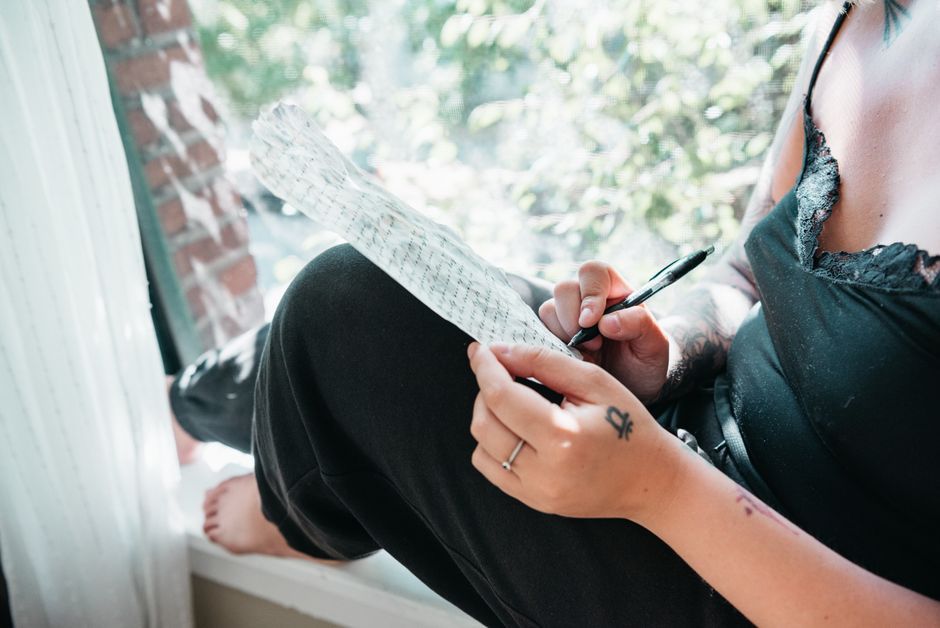
Then ask, without hurrying the answer. Where did I learn that taking up space was dangerous? And what if the apology I keep offering was never mine to make?
You are not too much. You are simply still running a rule that someone else needed.
FAQ
Is apologising too much a sign of anxiety?
It can be one feature among several, but a single habit does not identify a condition, and nothing you read online can. If reflexive apologising sits alongside persistent worry, dread, or avoidance, raise it with your physician or a licensed mental health professional.
How long does it take to change the reflex?
Most people notice the habit within days of paying attention, and notice it loosening over weeks to months as the underlying regulation improves. It tends to fade rather than stop, and it can resurface under stress.
Is it wrong to apologise at all?
Not remotely. A genuine apology is repair and it matters. The work here is only to return the choice to you, so that sorry means something when you say it.
This article is for educational purposes and is not medical advice. It is not intended to diagnose, treat, cure, or prevent any disease. Please work with a qualified practitioner, and consult your physician before making changes to your health routine.
In Renewal,
Lynette Wing
Founder of Renewal Health
Clinical Homeopath, Naturopath, Mind-Body Practitioner
Dedicated to root-cause healing and whole-person alignment. Guiding clients to emerge, align, and live fully, restoring vitality, clarity, and sustainable wellness. About Lynette